Fine Art Degree Show Exhibition 2026
Dynevor Centre for Art, Design & Media
Welcome
We have a world blurred by global events, yet within Swansea’s small but vibrant community,
16 undergraduates have been illuminating the personal, the private and the public through their individual expressions. 16 individuals, each researching their own perspective and expression through the kaleidoscope of contemporary life. Focusing on the complexities of the 21st century, each voice has questioned, dissected and rebuilt their own visual responses to pertinent issues, such as the environment, body politics, the lived experience, and defining their own alternative place within our complex world.
The same 16 individuals have been a united front, shown resilience and support collectively (with much humour on occasions). it has been a privilige to witness such a collaborative energy within a year group.
These same 16 individuals expressions offer an antithesis to our turbulent times and as they have collectively declared….. “By entering and absorbing the exhibition, you become the 17th expression”
On behalf of the Fine Art team, I would like to wish all 16 of you many great opportunities ahead and hope your collective humour and support for each other continues. You will be missed!
– Professor Sue Williams
Course Director of Fine Art – Studio Site & Context
Kesia Tucker
Kesia Tucker’s practice investigates the relationship between material, environment, and ritual through processes rooted in the natural world. Creating natural pigments, inks, and exploring organic matter, she approaches making as an alchemical act, exploring how elemental materials can evoke hidden, sacred, and liminal spaces. Her work is informed by an attraction to the sensory and emotional responses landscapes can provoke—particularly feelings of curiosity, wonder, and the quiet tension of encountering the unknown.
This body of work centres on the classical elements: earth, water, fire, and air, each represented through individual canvases constructed entirely from natural materials. At the centre sits a sculptural work representing ether, composed of a glazed ceramic base and woven willow form containing carefully selected found and handmade objects, partially submerged in water. The piece invites contemplation of both visible surfaces and unseen depths. Over time, these natural colours may subtly shift and evolve, reflecting the living, cyclical nature of the environments from which they originate.
Anastasia Sevcova
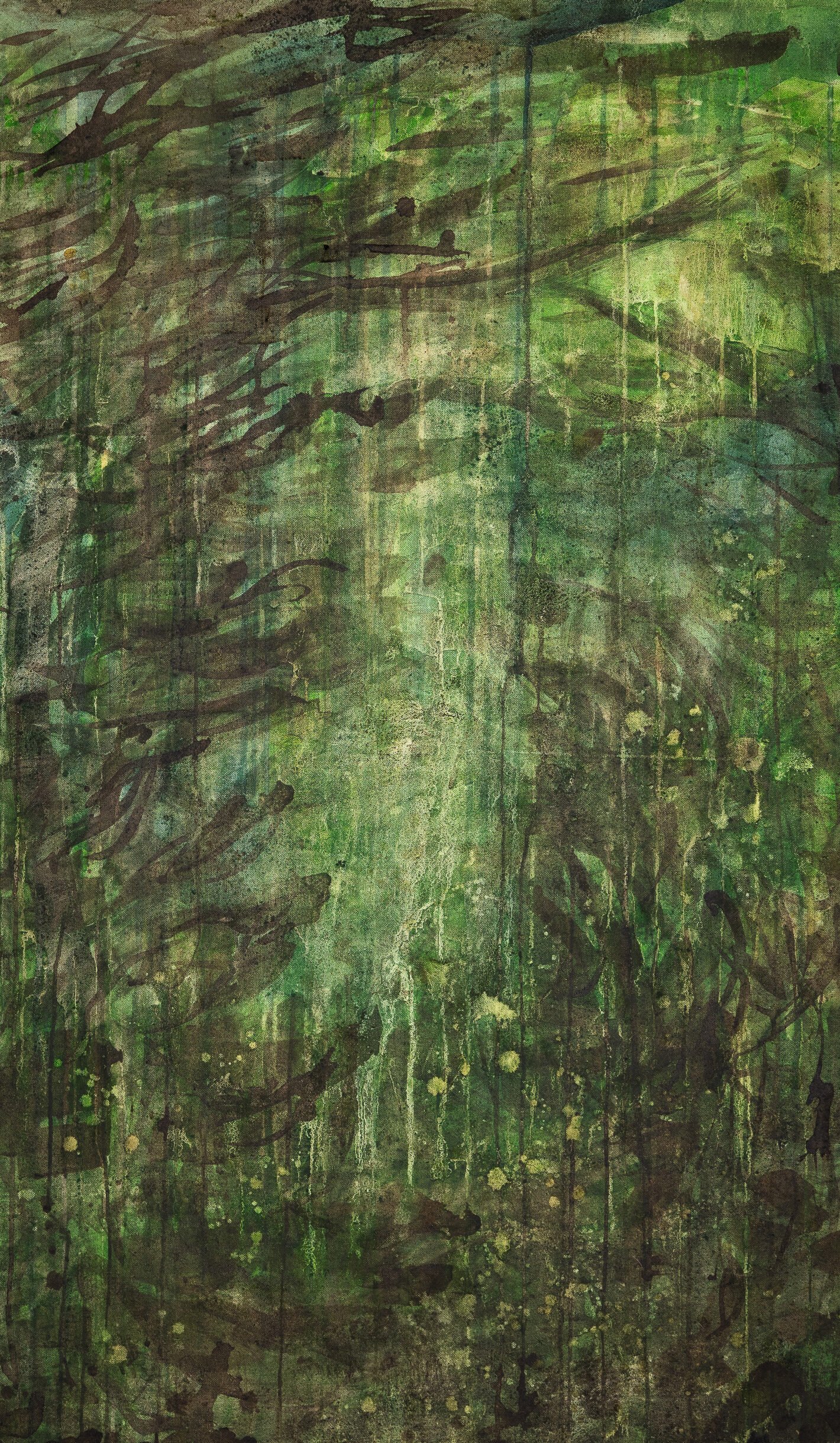
Anastasia’s practice focuses on exploring the connection between the environment, inner emotions, and the human experience. Working across painting, drawing, and printmaking she engages with ideas of space, relationship, and materiality through a process rooted in observation and intuitive response. Her work reflects an ongoing interest in the tension between order and chaos, the joy of life and the fragility of existence.
In her current body of work, the forest becomes a metaphor for the inner life – a dense, chaotic, and fertile terrain where thoughts, emotions, and memories intertwine like roots and branches within dense overgrowth. Through painting and drawing of local forests and gardens, Anastasia evokes states of confusion, disorientation, and emotional entanglement, while recognising that growth continues within this complexity. By portraying how life persists and even thrives amidst disruption, whether shaped by natural forces or human intervention, Anastasia seeks to capture the coexistence of disorder and vitality, revealing moments of resilience, beauty, and quiet hope within fractured expectations.
Sommer Ashbie
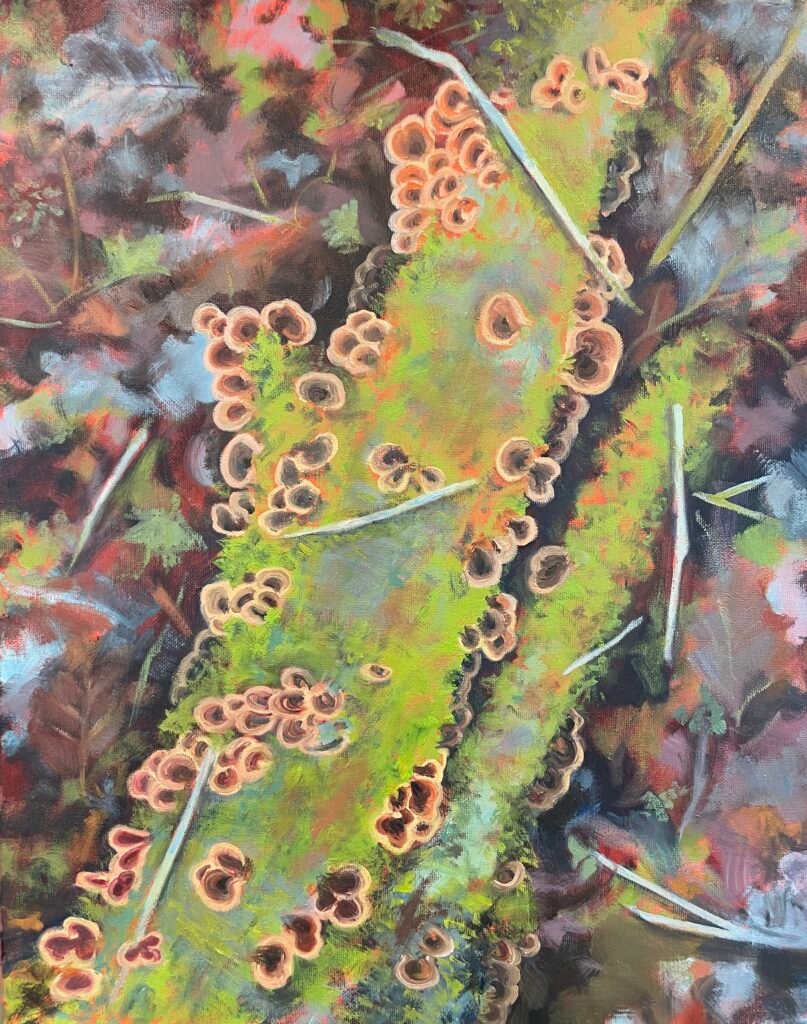
Sommer Ashbie is an artist whose practice centres on nostalgia and the human experience. Working primarily in paint, she conveys a personal sense of longing for the past while considering how memory continues to inform and shape her present. Her work moves through a psychological space, where recollections often distorted or fragmented linger within the subconscious and influence identity and perception. In her current body of work, Ashbie turns her attention to childhood, investigating ideas of innocence and belonging. She considers the many ways memory can surface, from feelings of yearning to moments of joy and quiet understanding. By focusing on these subtle, often overlooked experiences, she reveals how they accumulate to shape a sense of self. Through this approach, she encourages viewers to reflect on their own memories and recognise the enduring impact of fleeting moment.
Tilly Lewis
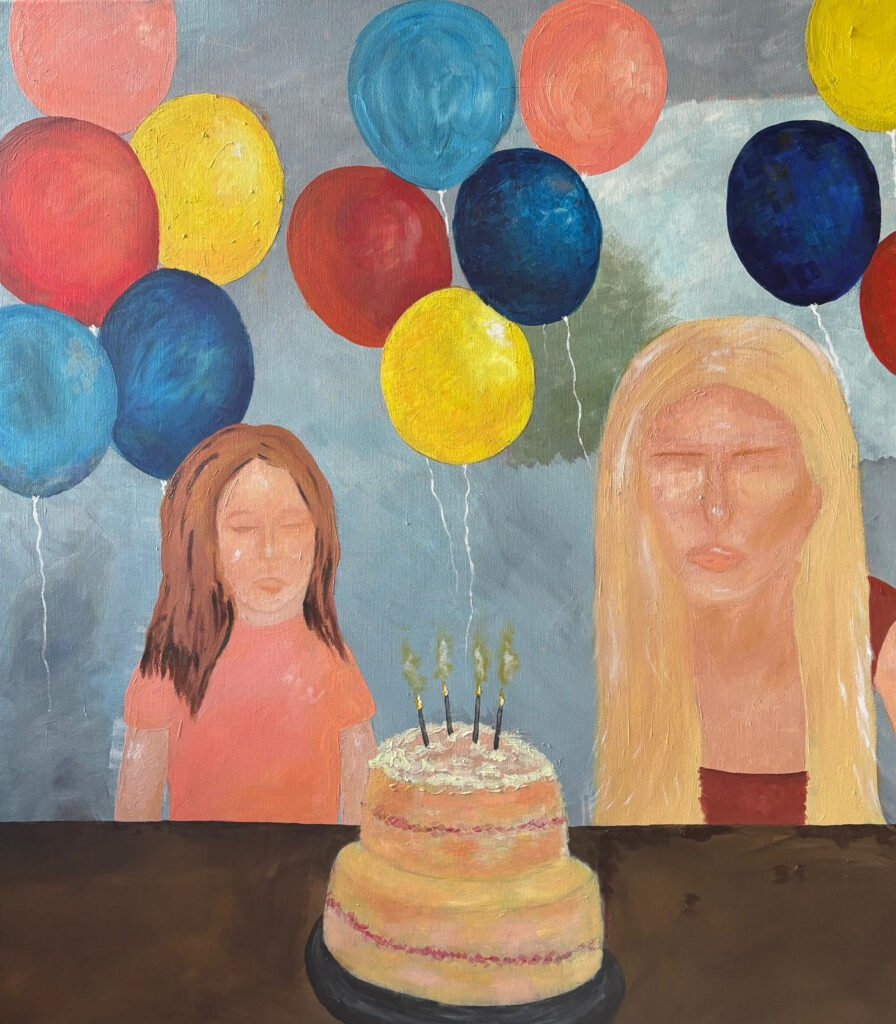
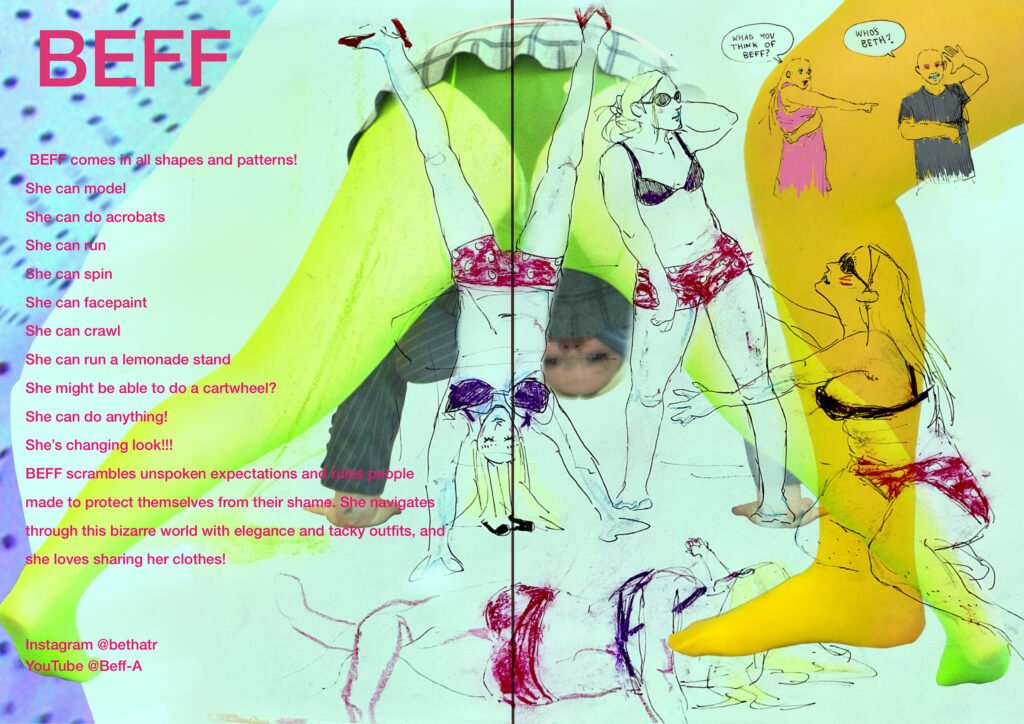
Tilly Lewis investigates flesh and body, using the unpredictable nature of watercolour to explore nudity and human nature. Her practice rejects mainstream representations of the body, diverting assumptions that flesh equals sex, or that nudity means pornography.
The abject nature of the body (particularly a feminine body) often disturbs audiences. Lewis is attracted to this disturbance and terms like ‘disgusting’ that we attach to the body, alongside tasks we undertake to conform to societal standards and purity culture.
Using paint and water as a documentary medium, she uses her form as a tool, a means to make an authentic impression of the body, fully immersing herself within the painting process.
Branwen Jones
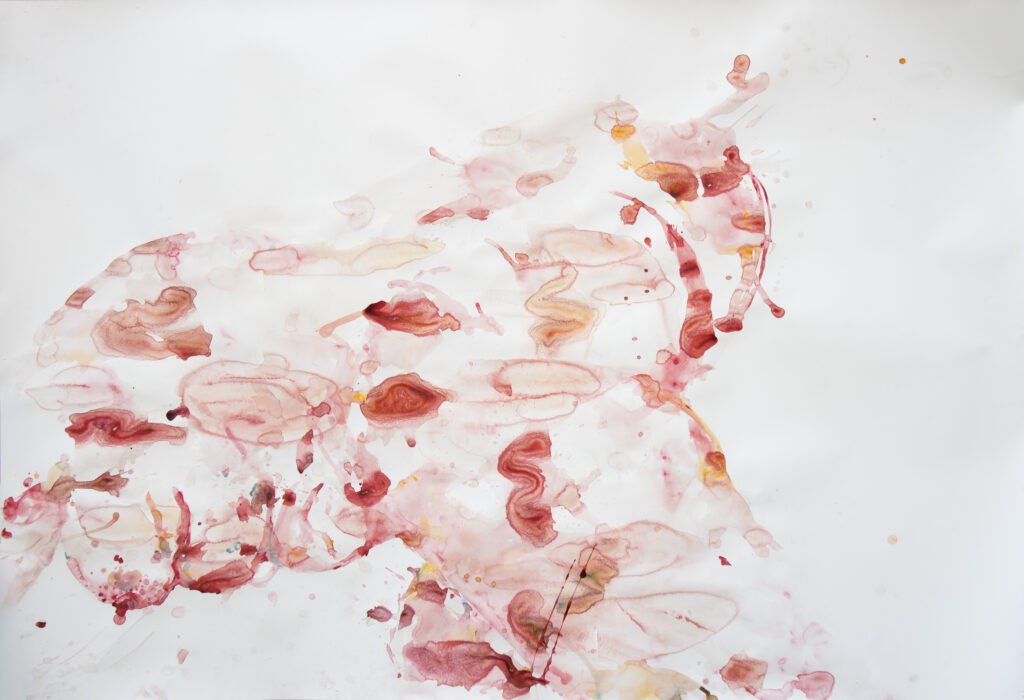
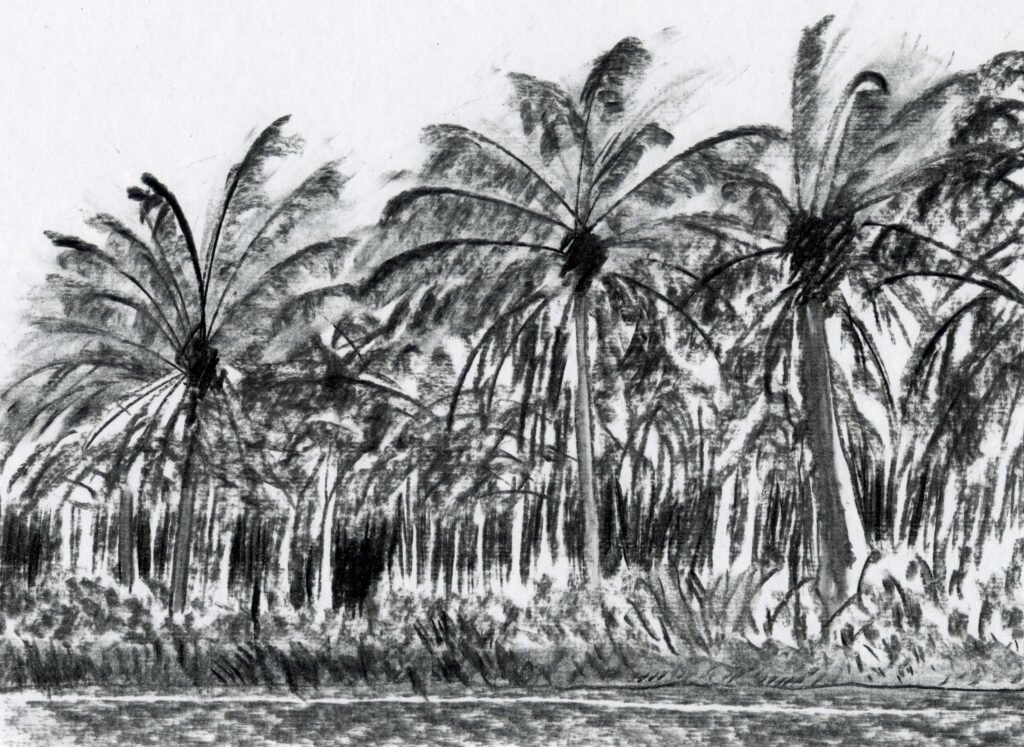
Branwen Jones’ practice explores the material fabric of everyday life and how histories and politics are embedded within this space. These might be histories of origin, production, trade and use – be it commercial or personal – or future histories of disposal and pollution.
Working across sculpture, drawing, printmaking, animation, and video, Jones’ current work examines the colonial histories of everyday commodities, reflecting on process and material.
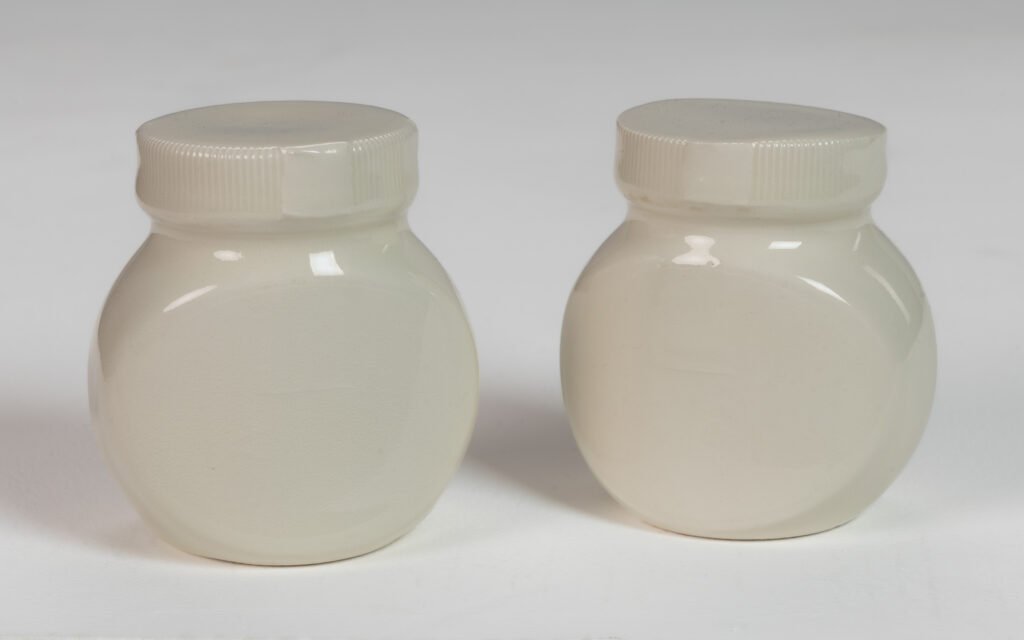
The process of casting has for centuries been used to make copies of statues and multiples of industrial goods. Europe eventually managed to decode and copy China’s method for producing porcelain, and then invented semi-porcelain, a cheaper earthenware alternative for mass production. These complex layers of meaning are evoked by numerous rows of blank semi-porcelain goods.
Ffion Harding-Thomas
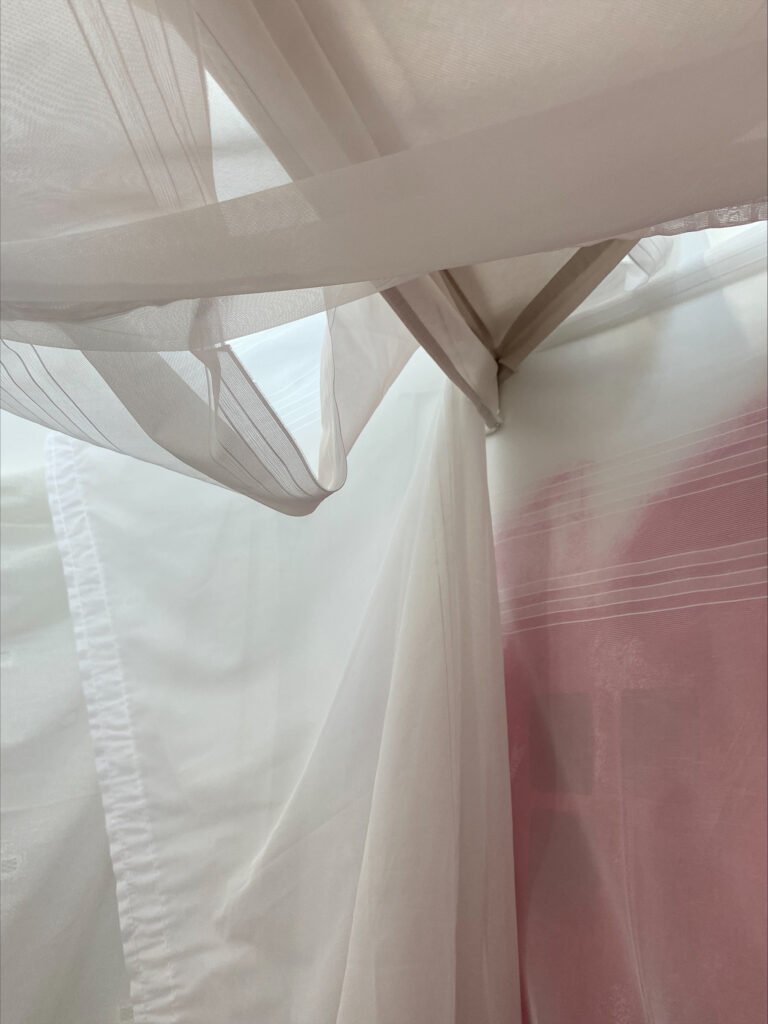
Ffion Harding-Thomas uses fabric installation to process trauma, grief, and healing, focusing on her own experiences and her healing process throughout the past year, using light gauzy fabrics contrasted with bright pink walls reminiscent of her first childhood bedroom. The mixture of healing and residual anger warring throughout the installation.
A small perfectly pink bedroom caused a lot of irreversible damage, with shaggy lilac carpets and blinding glitter mixed with wall paint. The bedroom offered a horrific mix of safety and cruelty wrapped in a perfect pink bow.
She prioritises fabrics that represent her feelings best, using thinner white fabrics to encapsulate her feeling of lightness and the relief of acceptance from processing her trauma over the last three years, the breathable fabric mirroring her now found ability to breathe freely after years of weighted grief.
Nia Davies
Davies explores the transformation and layering of natural materials as a way to process her personal experiences and emotions.
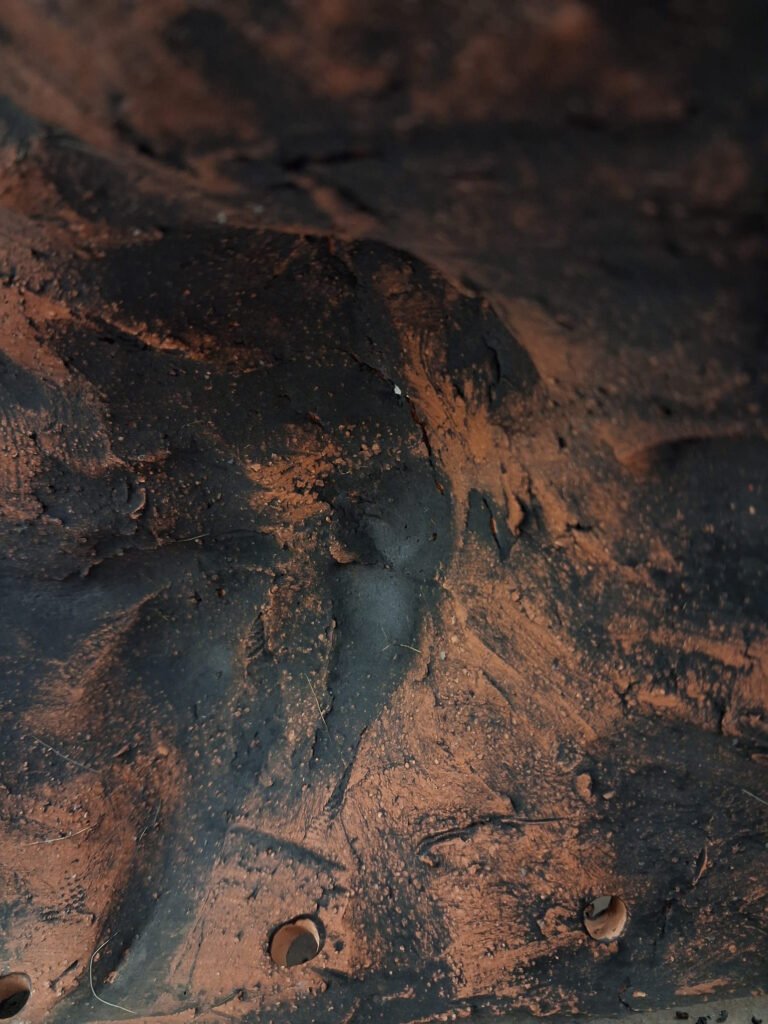
The work ‘Haenau’ combines her love of ceramics and painting; two ways of creating, coming together to form a work reflecting her memories and feelings. The large ceramic piece acts as a protective shell, with wire stitching being a metaphor for the patching of phycological scars held by the body, marking her lived experiences.
These scars are also shown in the layers of paint that cracked and crumbled from the wrapped form of the paper, a constant reminder of Davies’ mental battles. Layers showing through the cracks of a not-so-perfect life, where unfortunate experiences fade but never truly disappear.
Through these entwined materials, Davies reflects on memory, vulnerability and healing, inviting her viewers to find their own meanings within the work’s layered surfaces.
Aimee Brown
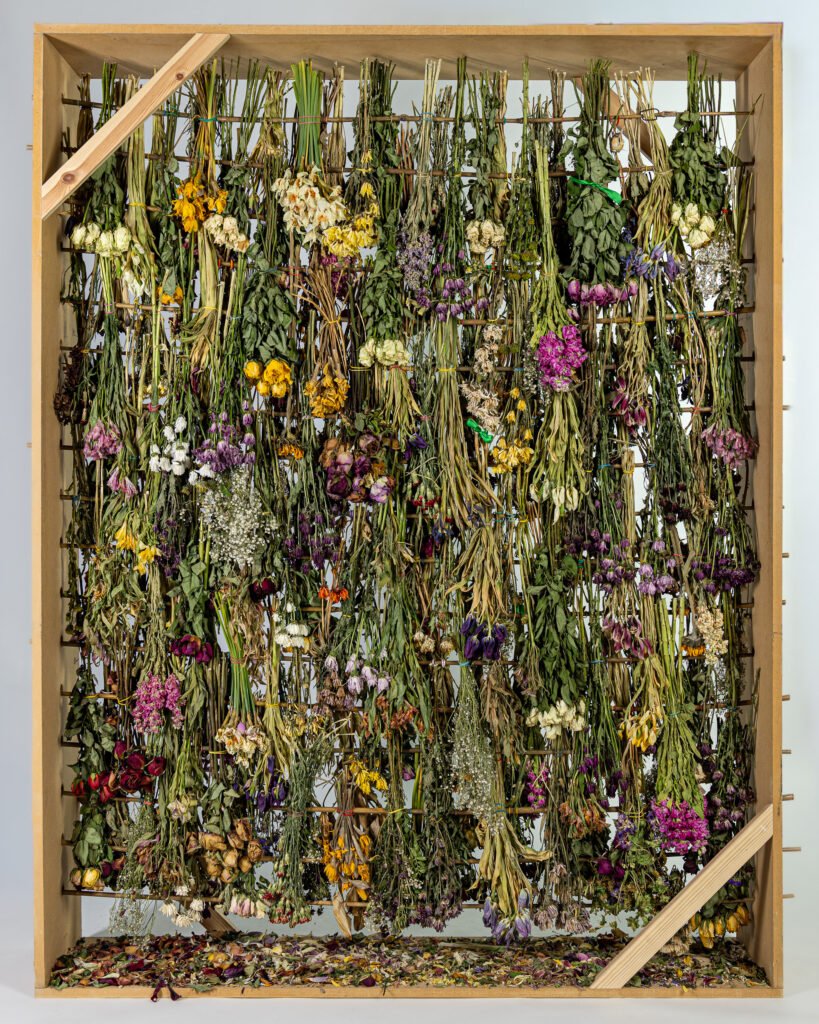
Aimee Brown explores themes of grief and loss within her work. Her practice considers the role of absence and nostalgia using found objects and flowers to create a permanent record of the loss of a loved one and the connection with the grief process. The series of ceramic tiles further echo the essence of grief with the impressions made representative of ghosts of an existence.
This theme continues with the In Memoriam which frames decaying flowers in various stages of decomposition; this piece explores the natural cycle of life through drawing comparisons between the decay of flowers and the absence of a loved one. A full sensorial experience, combining the visual appeal of flowers alongside their fragrance enabling the viewer to fully immerse themselves within the work emulating the all-encompassing effect of grief.
Flowers play a prominent part in Aimee’s work, demonstrating absence through presence, making a connection to flowers laid on gravestones that showcase a very public vision of grief, but also that the person laid to rest is still cared for and thought of.
H Balicka
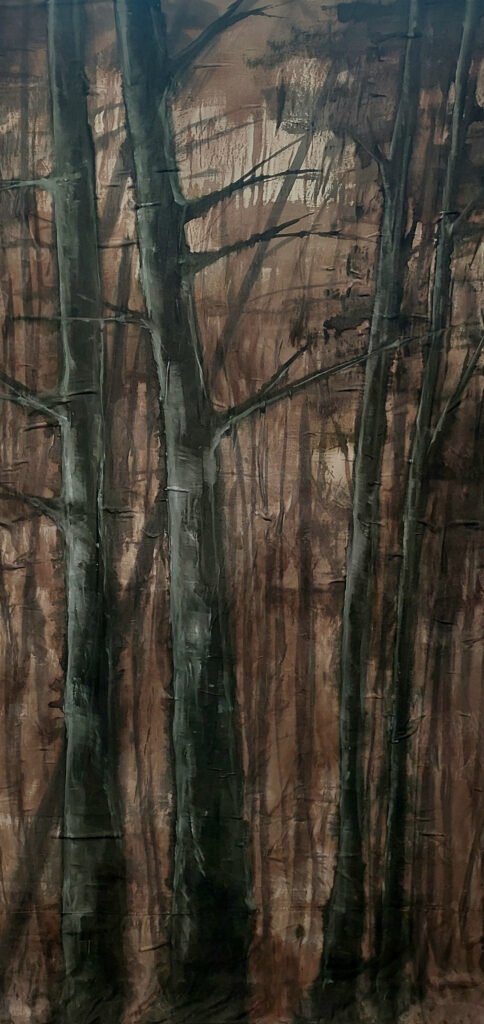
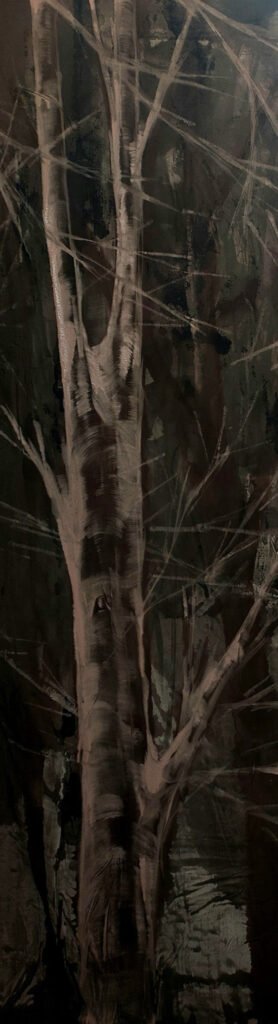
H Balicka explores the Forest as a representational landscape of the unconscious mind. They draw on Carl Jung’s archetypal theories, and the absurdist writing and attitude of Samuel Beckett, in order to interact with ideas of disorientation, growth and becoming endlessly lost.
Through painted fabric and immersive installation, Balicka creates environments that mirror the fragmented nature of dreams. Their practice investigates the tension between visibility and obscurity, inviting viewers to navigate layered surfaces and shifting forms. Here, the forest encourages introspection, where unconscious thoughts can be lost within the labyrinth of trees.
If you ask the leaves for directions, expect to only get more lost,
For the leaves will fall apart,
as they float into that one nightmare you thought was forgotten.
It is cold here.
May you wonder forever, oh tired one.
Eve Ellis-Delve
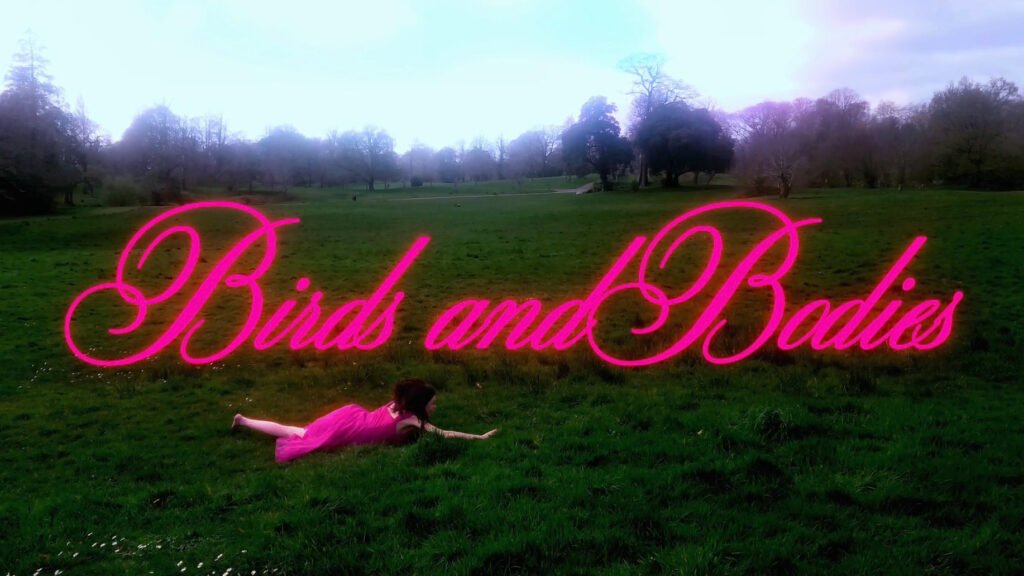
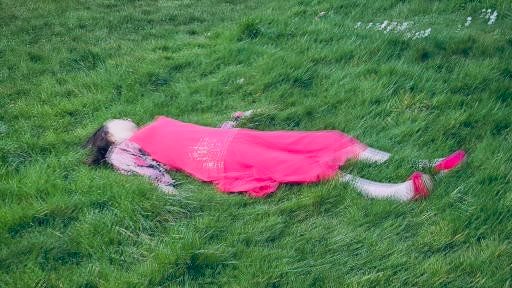
Eve Ellis-Delve is a multidisciplinary artist, working across video, installation and sound art. Her work considers states of being, belonging and the shifting edge between natural and constructed worlds. Her background in religion, continues to inform an ongoing exploration of belief, identity and place.
Delve’s work is deeply autobiographical, with each piece reflecting a specific moment or position in her life. She often places herself at the centre of the work, taking on the quality of a living portrait, one that documents not only how she sees the world, but how she exists within it.
Through immersive and sensory approaches, Delve examines what it means to occupy space, navigating the boundaries between organic and constructed environments, questioning how digital landscapes reshape our understanding of nature, selfhood and territory.
Cel Hopkins
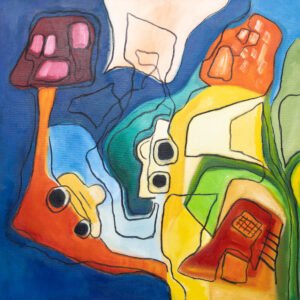
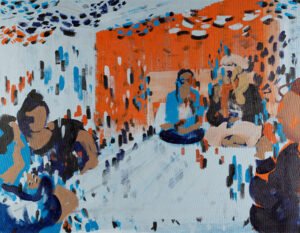
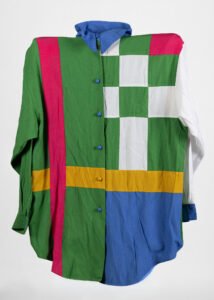
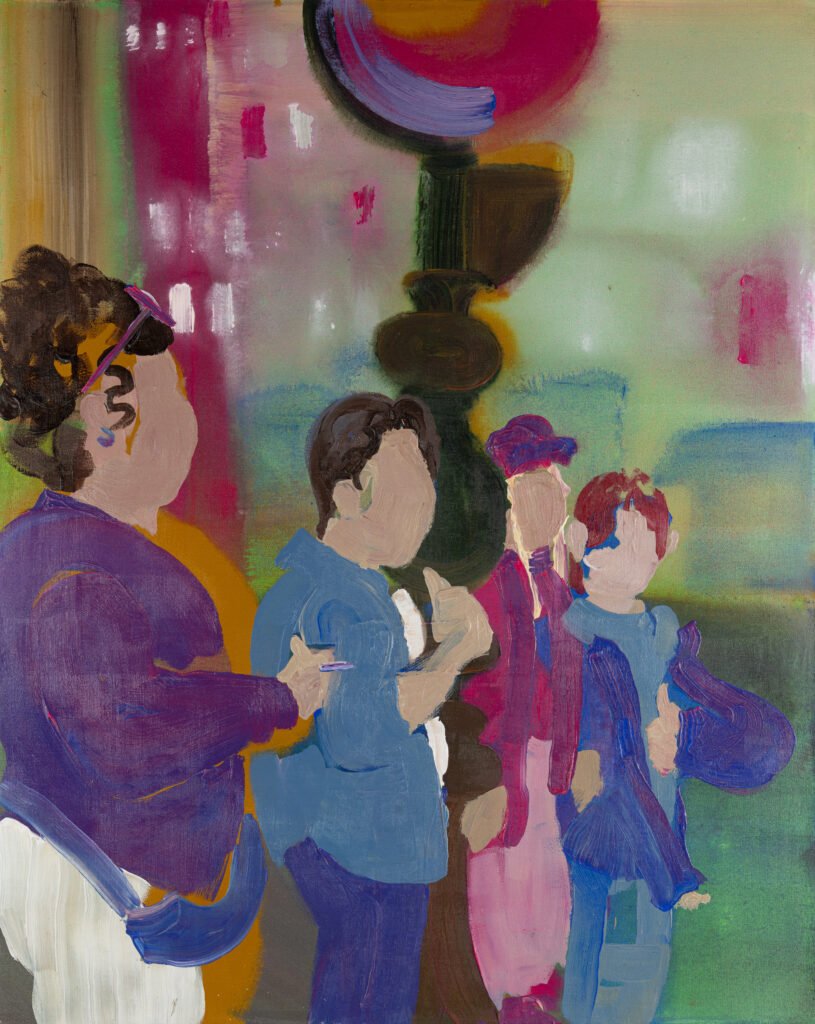
Cel Hopkins explores the depths of materiality and the power of matter. The artist’s practice revolves around the significance of colour, patterns, and paint, referencing imagery from their personal life. Hopkins’ paintings transport an audience into a world of colour, with abstract figures creating a dream-like reality, simultaneously haunting the image and giving a sense of nostalgia. This is a world drowned in pattern, ones taken from clothing that once held significance; ones given significance again at the artist’s hand.
Hopkins raises the materials of making to the status of art object: canvas frames, dried paint, scraped swatches of the leftover. They push the boundaries of what can be considered art by stretching clothing, exhibiting them as both painting and a ghostly audience; they are a spectacle of memory just as the images they observe. The swatches and pieces of paint further push the idea of memory and how what once was can change so significantly when touched upon with hand or head.
Scarlett Lewis
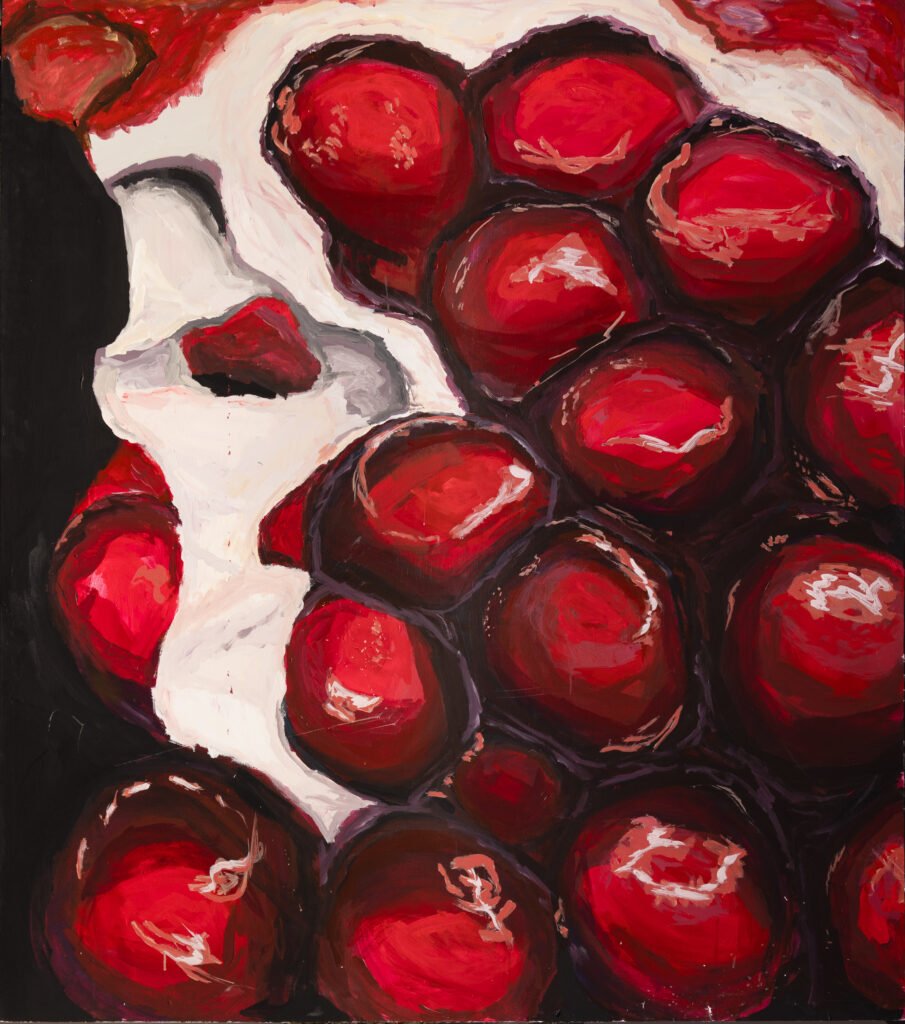
Through large-scale fruit paintings, Scarlett Lewis investigates the transformation of scale and elevating objects that are typically small and often overlooked. By enlarging these everyday forms, she disrupts familiar perception and invites closer attention. This shift encourages deeper engagement with surface, colour, and texture, allowing these qualities to become immersive and visually dominant. What is usually small and easily overlooked becomes more prominent within the space, altering perception.
Primarily focusing on pomegranates, Lewis is drawn to their intricate interior, where each seed varies in size and form. When enlarged, these subtle irregularities become more visible, revealing complexity within repetition.
Mair Phillips
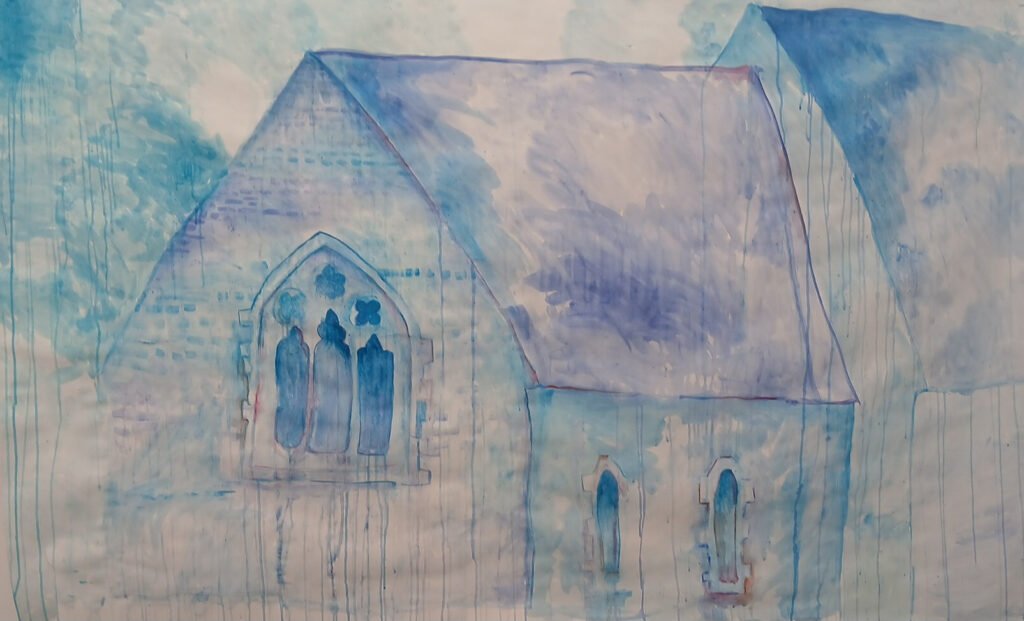
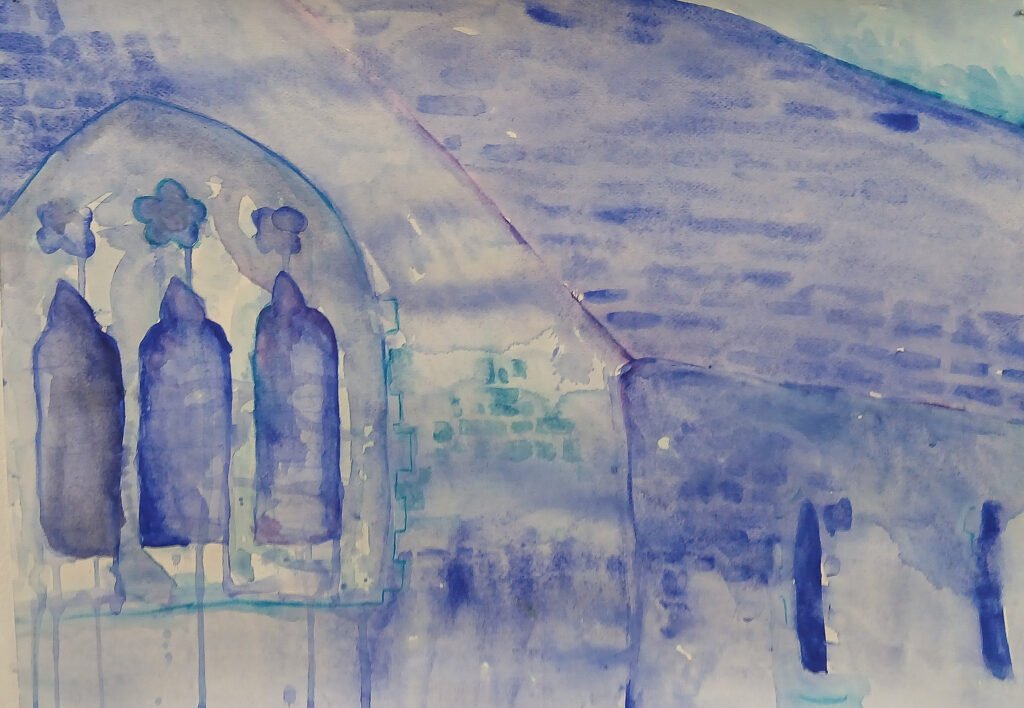
The artist’s work is a collection of small watercolour paintings of Welsh churches that are part of her ancestry and memories. Each painting is a different point of view of many different churches that they have visited. The paintings are done in a light and airy painting style where the artist lets the paint have a mind of its own. Phillips’s work is of the peaceful feeling that she feels and remembers when thinking about being in a church and has translated that feeling into their paintings.
Stephen ‘Bertie’ Bassett
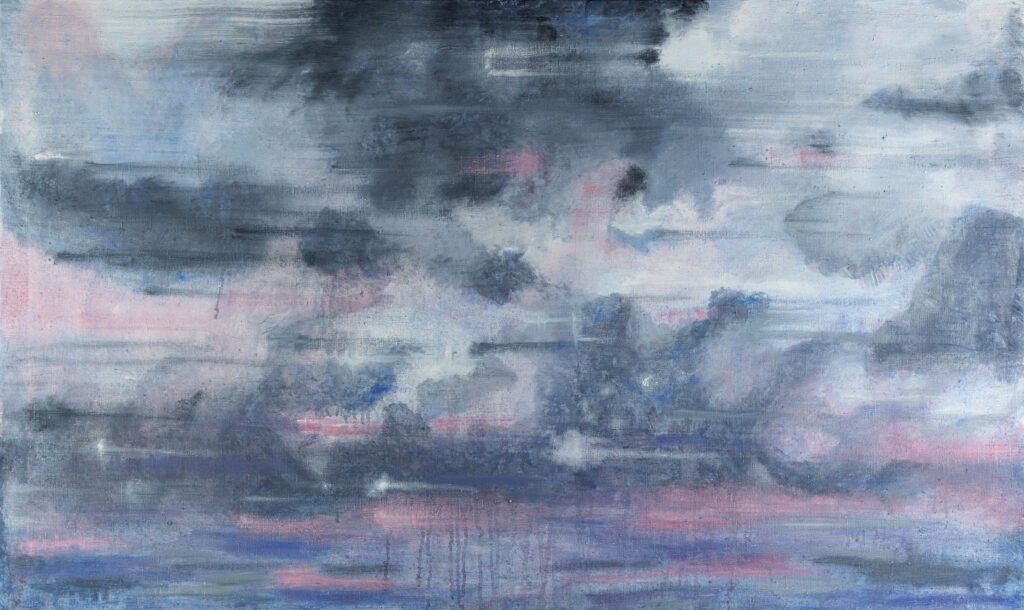
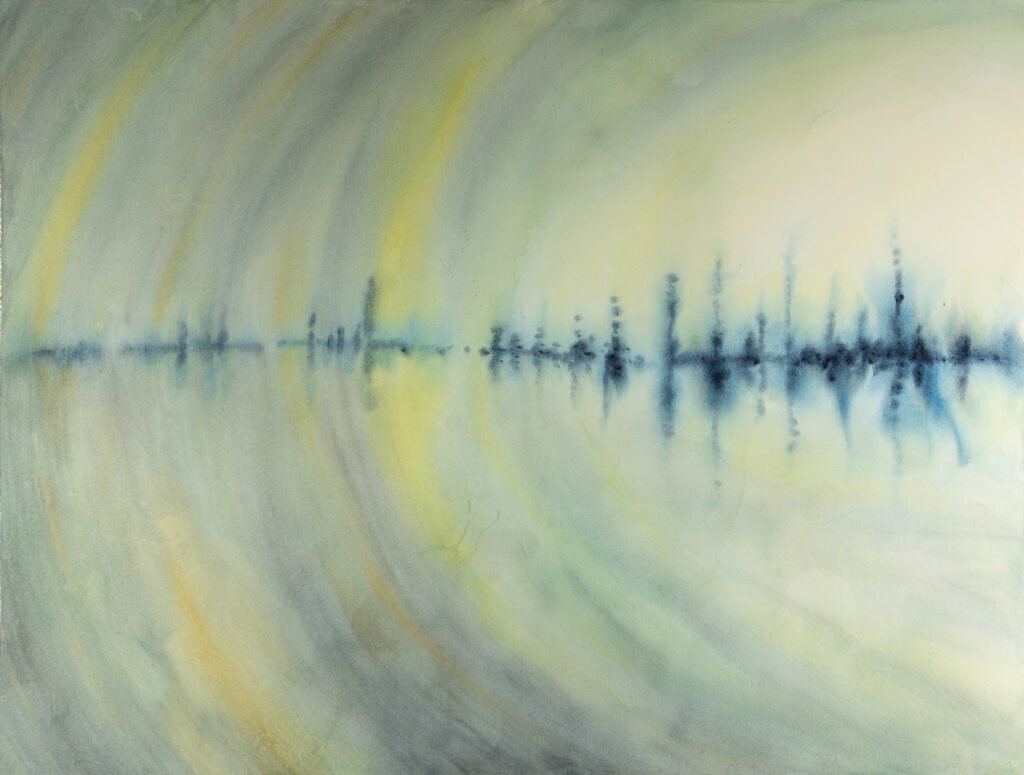
Stephen is an artist whose work is rooted in his observations of the landscape and his experience of the atmosphere in specific places. Rather than visual representations of places, he responds to the fleeting qualities of light, weather, colour, sound, and movement that define an environment.
Working across these two mediums allows Stephen to explore their different expressive qualities. Watercolour offers immediacy and fluidity, encouraging spontaneity as pigments move and interact across the surface. Oils, by contrast, provide richness, depth, and the opportunity for layering and reworking, enabling the gradual development of complex colour relationships and textures. Together, these processes reflect the shifting nature of the landscape itself, sometimes delicate and atmospheric, sometimes bold and dynamic. Each work becomes a reflection of how landscape can be felt as much as it is seen.